Electric Vehicle Transportation Center Hnei Current Stateoftheart of Ev Chargers
Electric Vehicle Charging Speeds
Electric vehicles can be charged using three charging speeds.
Level ane
The slowest, Level 1 equipment, provides charging through a common residential 120-volt (120V) Air conditioning outlet. Level ane chargers can take 40-fifty hours to charge a battery electric vehicle (BEV) from empty and five-6 hours to charge a plug-in hybrid electric vehicle (PHEV) from empty.
Level 2
Level 2 equipment offers charging through 240V (in residential applications) or 208V (in commercial applications) electrical service, and is mutual for home, workplace, and public charging. Level two chargers can charge a BEV from empty in 4-10 hours and a PHEV from empty in 1-2 hours.
Straight Current Fast Charging (DCFC)
The fastest speed, straight electric current fast charging (DCFC) equipment, enables rapid charging along heavy-traffic corridors at installed stations. DCFC equipment tin can charge a BEV to fourscore percent in just 20 minutes to 1 hour. Most PHEVs currently on the marketplace practice not work with fast chargers.
Shown below are typical Level 2 and DCFC charging stations.
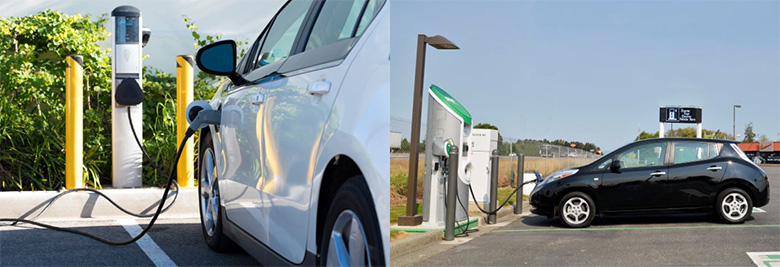
Overview of EV Chargers
The below tabular array summarizes the typical power output, charging time, and locations for PHEVs and BEVs for the different charger types. (Note: Considering the last 10 percent of charging an EV bombardment can take equally long as the beginning xc percent, for longer trips, it tin relieve fourth dimension to charge office-style [e.g., twenty to sixty percent] and bulldoze fewer miles between charges rather than recharge fully and drive more miles between charges.) For more information on the power requirements of different chargers, see the Utility Planning section of the toolkit.
| Level 1 | Level ii | DC Fast Charging | |
|---|---|---|---|
| Connector Type1 | J1772 connector | J1772 connector | CCS connector CHAdeMO connector Tesla connector |
| Typical Ability Output | ane kW | seven kW - nineteen kW | fifty - 350 kW |
| Estimated PHEV Charge Fourth dimension from Empty2 | five - vi hours | 1 - 2 hours | N/A |
| Estimated BEV Charge Time from Empty3 | twoscore - 50 hours | 4 - 10 hours | 20 minutes - one hr4 |
| Estimated Electric Range per Hour of Charging | 2 - 5 miles | 10 - xx miles | 180 - 240 miles |
| Typical Locations | Habitation | Home, Workplace, and Public | Public |


1 Different vehicles take different charge ports. For DCFC, the Combined Charging System (CCS) connector is based on an open up international standard and is common on vehicles manufactured in North America and Europe; the Charge de Move (CHAdeMO) connector is about common for Japanese manufactured vehicles. Tesla vehicles accept a unique connector that works for all charging speeds, including at Tesla'southward "Supercharger" DCFC stations, while non-Tesla vehicles require adapters at these stations.
2 Assuming an 8-kWh battery; near plug-in hybrids do non work with fast chargers.
3 Assuming a 60-kWh battery.
4 To fourscore percent accuse. Charging speed slows as the battery gets closer to total to forestall damage to the battery. Therefore, it is more cost- and time-efficient for EV drivers to use direct current (DC) fast charging until the battery reaches 80 percent, and then continue on their trip. Information technology tin can have most as long to charge the terminal x per centum of an EV battery as the first 90 percent.
Also in This Section

Adjacent Section

Last updated: Wednesday, February 2, 2022
Source: https://www.transportation.gov/rural/ev/toolkit/ev-basics/charging-speeds
0 Response to "Electric Vehicle Transportation Center Hnei Current Stateoftheart of Ev Chargers"
Postar um comentário