Can a Dryer Vent Be Next to a Door
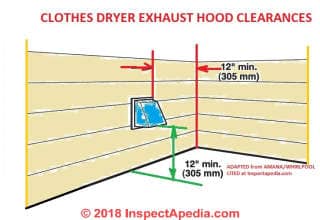 Clothes Dryer Exhaust Vent Termination Clearances
- Post a QUESTION or Annotate about clothes dryer exhaust venting, ducting installation procedures, codes, standards
InspectAPedia tolerates no conflicts of interest. We have no relationship with advertisers, products, or services discussed at this website.
Dress dryer exhaust vent clearance distances & specifications:
Dryer vent distance to gas meter, air conditioners, other building features. How far should the dryer vent exhaust opening exist from various edifice features?
What prophylactic hazards are caused if the dryer vent blows lint on to a gas meter regulator or onto an oil burner?
These conditions are unsafe, risking burn or explosion or loss of estrus.
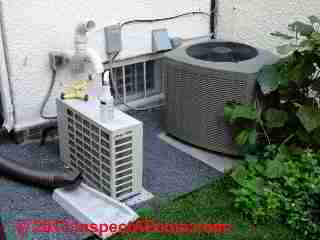
Page superlative photo: a dress dryer vent located just inches from an air conditioner compressor/condenser unit air intake screen risks clogging the condensing coil, causing A/C operating bug or even damage.
This article serial describes good practices for clothes dryer vent installation, lint traps, wall vents, filters, and screens.
We include a list of apparel dryer fire rubber hazards and other clothes dryer installation or maintenance mistakes that are either dangerous or that interfere with effective, economical dryer operation. Nosotros discuss types of dryer vent ducting and dryer vent doors or opening protection devices
We also provide an Article Index for this topic, or you tin endeavour the page top or bottom SEARCH BOX every bit a quick manner to find information yous demand.
Clothes Dryer Vent Termination Clearance Distances
Typical Clothes Dryer Exhaust Vent Termination Clearance Distances & Codes
Above: Amana / Whirlpool dress dryer installation manuals typically include the clearance requirements for the exterior wall dryer exhaust vent hood or "frazzle hood" including
- An exhaust hood should cap the vent to proceed rodents andinsects from entering the home.
- Do not employ an exhaust hood with a magnetic latch.
- Locate the vent such that there is no less than 12" (305mm) between the bottom of the exhaust vent hood and the ground surface
- Locate the vent such that in that location is no less than 12" (305mm) between the nearest side of a dryer exhaust vent hood and an bordering wall or building within corner
- No obstructions by snow, flowers, rocks, plants, fences, walls, air conditioner condenser/compressor units, etc.
- Install exhaust hood and use caulking compound to seal exterior wall opening around exhaust hood
- Vent must fit over the frazzle hood. Secure vent to exhaust hood with iv" (102 mm) clamp. Run vent to dryer location using straightest path possible.
Avoid 90° turns. Use clamps to seal all joints.
Do non use duct tape, screws, or other fastening devices that extend into interior of vent to secure vent, because they can catch lint. -
(Amana 2017)
Common Clothes Dryer Vent Termination Clearance Distance Questions & Answers
- DRYER VENT TERMINATION Distance to AIR CONDITIONER / HEAT PUMP / AIR INTAKE
- DRYER VENT TERMINATION DISTANCE to CEILING
- DRYER VENT TERMINATION CLEARANCE to COMBUSTIBLES
- DRYER VENT TERMINATION Comprehend, SCREEN, BIRDS, RODENTS
- DRYER VENT TERMINATION Altitude to GAS METER or REGULATOR
- DRYER VENT TERMINATION Distance to GROUND
- DRYER VENT TERMINATION DISTANCE to DOORS or WINDOWS
- DRYER VENTING CLEARANCES in INTERIOR WALLS & CEILINGS
- DRYER VENT TERMINATION to H2o HEATER, OIL BURNER, GAS BURNER
Dryer vent clearance to Air Conditioner, Heat Pump, motors, heating equipment, air intakes
Question: altitude from dryer vent to A/C or heat pump condenser unit
(May ten, 2015) Ryan said:
Is there any minimum distance standard that a dryer vent should terminate away from a A/C condenser? My neighbors dryer vent terminates about a human foot abroad from his condenser.
It seems to me that this could allow lint to accident all over the fins of the condenser reducing efficiency and possibly shorten the life of the condenser. Any idea? Cheers.
Reply:
Ryan
Clearance distances for air conditioners are given
at CLEARANCE Altitude, HVAC
I haven't found a lawmaking citation specifically addressing wearing apparel dryer clearance to AC unit condensers simply that topic is discussed in the article I cite above.
I agree that regardless of altitude, if lint is clogging the condenser fins that'due south going to exist a problem. There likewise *might* be a trouble from hot air exiting close to the condenser too.
Reader Question: 2016/03/24 Stephanie said:
What is the required distance betwixt a through the outside wall directly furnace vent and a dryer vent.
I'm renting and they are very close together. I tried to find the requirements myself just was unsuccessful.
Give thanks you so much
This question appeared originally
at INDOOR AIR QUALITY IMPROVEMENT GUIDE
Reply:
Stephanie: if the directly vent furnace air intake tin pull in lint from the clothes dryer the installation is dangerous.
Lint clogging the direct-vented furnace could result in vent overheating and possibly a building fire. But that's a subjective stance on my office as I take not seen an explicit clearance distance stated in model building codes nor installation instructions.
at Direct VENTS / SIDE WALL VENTS nosotros find a more general clearance specifications that in my view serve every bit a reasonable model-answer to your question. I quote:
- The frazzle vent final shall be located at least 3-feet above any forced air inlet located within ten-anxiety.
Come across [the figure in the original article cited higher up] for a depiction [courtesy of Thermo Pride] of the minimum required clearances between vent terminations and edifice features according to the National Fuel Gas Code (NFGC).[19]
 This article and thus my suggested specification (x anxiety) recognizes that dryer lint can clog a key vent such as on a gas regulator at a distance of 4 feet nd that a significantly greater altitude would exist needed for prophylactic clearance between a clothes dryer vent outlet and the air inlet of any mechanical system such as a direct vent chimney sidewall or rooftop penetration.
That's a reasonable minimum distance of 10 feet.
The local building code official is the last authority on questions like this, especially every bit there may be site conditions that for safety should change general safe clearance altitude recommendations
at A/C CLEARANCES from OTHER MECHANICALS
where we talk over distances from a dryer vent to an air conditioner compressor, nosotros include the following:
In our photograph higher up, from a Minneapolis MN dwelling house, these two compressor/condenser units are just about 3 anxiety apart - a trivial close, and that right-most larger compressor/condenser unit of measurement is as well close to building walls, a apparel dryer vent, and shrubbery.
Nosotros likewise see that direct-vented heating appliance white PVC pipage is bravado exhaust close to these units. The installation is nice-looking and not bad though.
- Clothes dryer vent outlet: Do not locate a compressor/condenser unit of measurement where the clothes dryer vent will blow onto or close to the unit.
Lint-clogging of the compressor/condenser'southward condensing coils is likely to be a trouble and the actress warm air won't help the cooling cycle efficiency or equipment life. Move the equipment or motility the dryer vent.
- Heating apparatus direct vent outlet: Do not locate the outdoor HVAC compressor/condenser unit where exhaust from a straight-vented heating appliance will blow onto the unit of measurement.
Dryer Vent Termination to Ceiling
Question: how far a wall mounted dryer should be from the ceiling
(Dec 28, 2015) Anonymous said:
Is there a constabulary/guideline how far a wall mounted dryer should be from the ceiling
Respond:
Anon:
Check the installation instructions for your clothes dryer - the manufacturer will give the necessary clearance distances.
Common sense will also tell us that the dryer opening and controls have to exist readily accessible by a user standing on the flooring.
Dryer Vent Termination Needs a Embrace: Continue out Drafts, Rodents, Birds, Mice
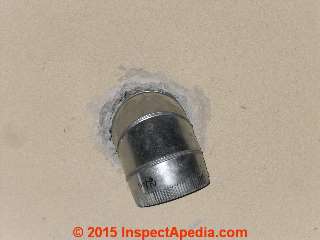
Dryer vent termination hoods should accept a cocky-closing flapper or door to prevent back-drafting of cold air into the building. This door or flapper, properly maintained, also helps proceed mice, birds, insects or other pests out of the dryer vent - a potential cause of fires as well as an interference that increases apparel drying time and price.
An InspectApedia.com reader provided photographs of a wearing apparel dryer exhaust vent termination on the edifice's exterior wall.
Above we see that at that place is no proper cover on this dryer vent: birds, rodents, or someone else can enter the dryer vent, nest therein, block upwardly the dryer vent, and cause a dryer fire or a edifice fire.
See details at Wearing apparel DRYER VENT TERMINATION & SCREENS
At DRYER VENT DISTANCE to GAS METERS we see more trouble with this ugly dryer vent installation:
Minimum Burn Clearance distance from clothes dryer vent to foam insulation products
Reader Question: 2017/06/03 Ron said:
is steel dryer vent OK to apply confronting polystyrene insulation
Respond: take a look at dress dryer operating temperatures, cream insulation ignition signal, and the effects of thermophoresis
Ron, I haven't found a model building code citation specifically regarding dryer vent clearance from foam insulation products and I don't think there is one.
A curt respond offered by some plumbing experts is that every bit long equally yous are meeting other dryer vent code requirements such equally length restrictions your organisation should be accepted by your local code officials.
Clothes dryers used in residential settings commonly operate between about 125°F to 135°F. The maximum operating temperature of a clothes dryer under varying conditions might exist possibly 176°F.
Thermophoresis, a chemic change that lowers the ignition signal of many edifice materials, is unlikely to occur below almost 200°F.
Dryer outlet temperature will likewise vary depending on local conditions such as the temperature of air entering the wearing apparel dryer.
These are in-dryer temperatures or temperatures measured at the dryer vent outlet. The temperatures within the dryer heating element may exist much higher.
Details are at Clothes DRYER TEMPERATURES
Lookout man out: however some combustible foam or other building products close to or in contact with a clothes dryer vent might increase the risk of a building fire in aberrant conditions such as an abnormally-hot dryer vent caused by other problems (lint bottleneck, for example). A clothes dryer with a lint-clogged lint trap or exhaust can reach temperatures over 750°F, or 400°C. That'southward enough hot plenty to lead to ignition of some materials.
The ignition point of polystyrene insulation, defined as the "transfer ignition temperature" is around 680°F or 360°C.[California Burn down Marshall & EUMEPS] That's below the temperature given above for a lint-clogged clothes dryer.
Burn Safety and EPS and Dryer Vents: OPINION: And then even if information technology is enclosed inside a edifice wall or ceiling cavity, where it might be in contact with a clothes dryer vent it would be smart to cover your polystyrene insulation with a layer of fire-resistant drywall, just as you'd be required to embrace such insulation if it were exposed in the living surface area.
- BEHAVIOUR of EPS in Case of Fire [PDF], Eumeps (Structure), Artery Marcel Thiry 204, B-1200 Brussels, Kingdom of belgium, Tel: +32 2 774 96 twenty, Email: eumeps@eyam.be, August 2002, cited in the U.South. by the California Office of the Country Burn down Marshall, CAL FIRE, retrieved 2017/06/03, original source: http://osfm.fire.ca.gov/codedevelopment/pdf/wgfsbim/EUMEPS_FireBehavior.pdf
- CLOTHES DRYER Projection, Last Report on Electric and gas Clothes Dryers [PDF] February 2000, U.s. CPSC, retrieved 2017/06/03, original source https://world wide web.cpsc.gov/s3fs-public/clothes_0.pdf
- Final Report on Electric Wearing apparel Dryer and Lint Ignition Characteristics, May 2003, [PDF] includes Letter, Jacqueline Elder, US CPSC to David Calabrese, Association of Habitation Appliance Manufacturers [PDF], U.South. Consumer Product Safe Commission, 21 November 2003, retrieved 2017/06/03, original source: https://www.cpsc.gov/s3fs-public/electric_2.pdf
See THERMOPHORESIS for an caption of how exposure of building materials to elevated temperatures might lower their ignition point
Dryer Vent Termination Ground Clearance
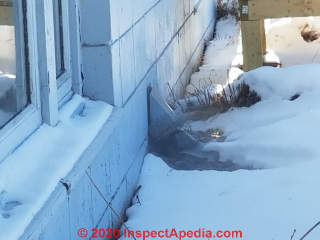
Photo: a clothes dryer exhaust vent terminating merely an inch or 2 to a higher place basis level at this northern Minnesota home is unsafe for several reasons:
It is as well close to basis so may non vent properly and is at risk of becoming blocked by deep snow cover.
Not visible in this photo, the dryer has no flapper closure only instead sports a screen that becomes lint clogged.
These faults risk a vent blockage, dryer overheating, increased price to and longer fourth dimension to dry wearing apparel.
This dryer vent is also plagued with mice at the onset of winter.
See details at Dress DRYER VENT TERMINATION & SCREENS
Question: is 24" clearance from dryer vent to ground safe for a thirty foot dryer vent run?
Noah said:
My electric dryer vent, later effectually 30' of more often than not rigid straight pipe, terminates to the exterior through a downward facing vent that has at least 2' of infinite beneath (before the ground) and likely a reasonable amount of air flow otherwise from left to right.
Should I be concerned here? Any reason I admittedly demand outside admission? Annihilation I should practice?
Answer:
Noah
The minimum clearance altitude from the bottom of a clothes dryer vent terminating hood to the surface of the ground or to the surface of whatsoever other obstruction is 12".
In areas of deep snow comprehend that distance may be inadequate.
Your installation acme audio reasonably skillful to me, though in areas of deep snow or if exposed to freezing there could be a rubber worry if the vent tin can become blocked past snow or ice or frozen condensate.
That 30 feet is a long run, maybe longer than the dryer manufacturer recommends. I'd check for soot clogging in the organisation from fourth dimension to time. If you notice apparel taking longer to dry or the dryer running extra hot those are signs of unsafe dryer vent blocking.
Dryer Vent - Gas Meter Clearance Distance
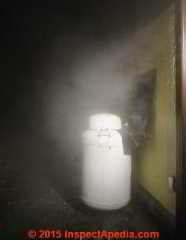
Photo: we encounter a deject of moist air blowing out of the dress dryer exhaust vent and down onto an LP gas tank.
Nosotros take more than the required 3-pes clearance betwixt the dryer vent outlet and the LP gas regulator,
and nosotros noted that the gas regulator located outdoors and atop the LP tank is every bit a bit of boosted protection from this smash of wet and lint by a rubber cover.
The gamble of clogging the regulator's relief valve opening by lint or as you can run into, by frozen moisture at this northern abode is a credible one.
We inspected the regulator for lint clogging (none) and during freezing conditions for ice clogging on the regulator assembly (none).
What about a dryer exhaust vent that's blowing onto a nearby gas meter or regulator?
Spotter out: In our opinion this is potentially dangerous: dryer lint can accumulate on and even clog or cake safety vents institute on both LP gas regulators and on Natural Gas meters and regulators.
Beneath: nosotros see that in that location is no proper embrace on this dryer vent: birds, rodents, or someone else tin enter the dryer vent, nest therein, block upwards the dryer vent, and crusade a dryer fire or a building fire.
An InspectApedia.com reader provided this pair of photographs of a clothes dryer exhaust vent termination on the building'southward exterior wall.
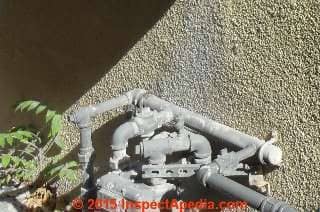
The clothes dryer vent, located well-nigh 20" above the outdoor gas meter is blowing lint all over the gas meter and its various parts.
This might seem harmless but it's not. Lint blockage of the vent port on a gas regulator valve tin can crusade a unsafe gas leak inside the edifice risking a burn down or explosion.
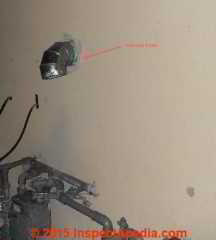
I haven't found an explicit model edifice code giving a minimum clearance distance from a dryer exhaust vent opening to a gas meter (or to the meter'due south regulator).
The minimum distance of three feet clearance from the gas meter to the clothes dryer intake or exhaust vent opening is given by the article cited below.
You'll see the three-foot rule commonly cited by gas visitor specifications such as our second commendation just below.
- See GAS METER CLEARANCE DISTANCES
- Puget Sound Energy, Inc., "Gas Meter Clearances and Service Installation Requirements(March 2016)", [PDF] new retrieval, iii/26/2016, original source: https://pse.com/accountsandservices/Construction/Documents/3885.pdf
- Amana Electrical DRYER INSTALLATION MANUAL [PDF] (2017), Whirlpool Corporation, Website: world wide web.whirlpool.com retrieved 2018/12/07, original source: https://amana.com/avails/amana/pdfs/INSTALLGUIDE/NED4655EW_Installation%20Instruction_EN.pdf
Heather:
The two worries, I suspect, nagging at your maintenance guys were
one. lint and grit from the wearing apparel dryer may clog the combustion air inlet of your gas fired heating furnace, causing unsafe conditions and risking fatal carbon monoxide poisoning.
2. They might miss a gamble to sell yous a lint filter that you not only don't need, but that depending on the type and installation might itself be a serious burn down run a risk.
If your clothes dryer is properly and safely vented to the building exterior, the release of lint around the dryer itself ought to be minimal and not a safety hazard.
Start with a practical examination: is there dust visible in, on, or around your gas fired heating equipment? Is that grit dryer lint? If so, then a combination of housecleaning and an inspection of the dryer for dust and lint leaks is in guild regardless of the dryer's exact placement.
Two anxiety more or less distance change from a apparel dryer that'due south leaking lint would non make 1 iota of deviation in safety.
Working space or fire clearances from combustibles that volition exist specified in the gas furnace installation manual for your specific heater. If the dryer is installed too close to the heater it violates the manufacturer's instructions, may prevent proper heater maintenance, and might exist dangerous.
See FURNACE CLEARANCE DISTANCES for details most the required distances around a gas fired heating furnace.
Dryer Vent Clearance to Exterior Walls & Windows
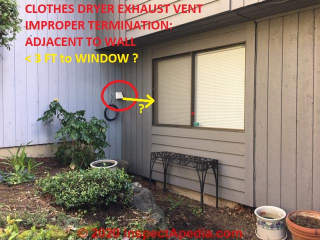
Live in Oregon. Neighbor's electric dryer exhaust located adjacent to common wall and exhaust fumes blow into bottom and upstairs windows and into crawl infinite. Extremely heavy detergent scent invades home causing wellness problems (like soaking a mask in concentrated detergent and wearing information technology half-dozen-10 hours animate detergent aroma).
Never ending lint on windows/screens/siding. Neighbor runs dryer xxx-40 hrs weekly - unable to open windows even when exterior temperature exceeds ninety degrees. Mold institute in cupboard side by side to bordering wall (no water pipes in this area).
Metropolis inspector stated no code violations? HOA stated it is not a nuisance. Multiple contractors (plumbing, HVAC) have noticed and claimed it violates lawmaking.
Could this be a lawmaking violation?
[Photograph shown above]
Lucy,
Curt answer: yes.
Your clothes dryer vent is almost certainly not installed according to the installation instructions from the dryer manufacturer.
Give us the make and model of your dryer and together we can check what clearance distances are specified by your detail manufacturer.
An example is show in the article to a higher place on this page at "Typical Clothes Dryer Exhaust Vent Termination Clearance Distances & Codes"
Technically, if mechanical equipment is non installed according to the manufacturer, it will be thus in violation of local edifice, mechanical, plumbing, or electrical codes.
However, unfortunately, your local building code compliance inspector is the final legal say-so. If she says something is acceptable, then yous're not going to be able to get any help from your local authorities.
Try instead offering to your neighbour to pay or share the cost of correcting the installation.
Above on this page we requite examples of dryer vent clearance distances in the building codes, excerpted from the IRC (International Residential Code) as adopted by Texas but pertinent in most US states, illustrating the full general "code" requirement that equipment must be installed according to the manufacturer'south instructions.
Hither is an example, from the IRC (International Residential Code) as adopted by Texas but pertinent in most United states of america states, illustrating the full general "lawmaking" requirement that equipment must be installed according to the manufacturer's instructions:
IRC UMC M1502.2 Duct termination.
Frazzle ducts shall terminate on the outside of the building or shall be in accordance with the dryer manufacturer's installation instructions.
Exhaust ducts shall terminate not less than iii feet in any direction from openings into buildings.
Exhaust duct terminations shall exist equipped with a backdraft damper.
Screens shall not be installed at the duct termination.
Thanks for your comments. Do not know model of neighbor'south dryer. Information technology is replaced most every three-iv years.
Neighbor is not cooperative and will not move dryer vent or provide dryer make/model.
Neighbor claims dryer is installed in accordance with manufacture instructions.
Neighbour is wrong.
Ib building department won't get involved,
Looks as if we need to focus on protecting your home,
Dryer Temperature vs Clearance Distances in Walls Penetrated by a Wearing apparel Dryer Vent
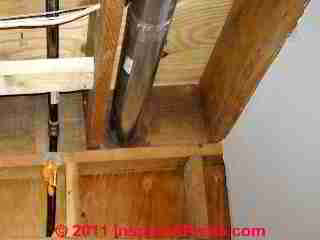 Question: clearances or specifications for walls penetrated past clothes dryer frazzle vent
Brady Bisel said:
I can't seem to discover anything pertaining to the specs for walls that the dryer exhaust vent is cut and routed to.
Past that I hateful whatsoever specs on the proximity of insulation in wall cavities surrounding dryer exhaust duct and drywall or other wall materials like wood paneling that are combustible and whether or not there needs to be an inch or more space of any of the in a higher place mentioned materials?
This question and reply were posted originally
at CLOTHES DRYER VENT INSTALLATION
Photograph to a higher place-left: the gas fired clothes dryer vent during original construction - before being covered past insulation - in the domicile whose gas fired clothes dryer measurements are described above
at Apparel DRYER TEMPERATURE MEASUREMENTS
An older dryer and dryer frazzle vent in this dwelling house were found to be almost completely blocked by lint - shown
at CLOTHES DRYER FIRE HAZARD WARNINGS. Owners had observed wearable coming out of the dryer "extremely hot" and compensated by always running the dryer on its lowest heat setting.
Answer:
Thanks for the corking question, Brady. I appreciate information technology because you point out an area that we should clarify:
Clothes dryer vents are more often than not installed as zero-clearance, that-is, in direct contact with wall exterior covering (siding), wall framing, insulation in the wall cavity and the interior wall covering.
The reason that direct contact between the dryer exhaust vent and building materials is safe *in normal and proper operating conditions* is that normal dryer operating temperatures in the dryer drum range betwixt 125F and 135F. (GE Corporation, ret. 2017).
The highest temperature claim I've read is 150 degF (perhaps an unsubstantiated opinion).
The air temperature of air exiting the dryer'due south heater and at the betoken of entry into the dryer drum or "tumbler" may be hotter, at around 175 F.
The highest temperatures occurring inside the clothes dryer are in the heater element or burner itself where they can attain between 250˚ C and 400˚ C (Marks, 2012) as cited in Bonaccorso (2012) in what I find is i of the most informed studies of wearing apparel dryer temperatures and fire rubber.
I have added links to this inquiry in the list of references and research in CLOTHES DRYER Burn RESEARCH - you may need to clear your browser cache and wait 24 hours for amendments to this spider web page to announced in your server.
These temperatures are well below the point of pyrolysis - 200-300 °F (93 - 150°C) - at which a chemic modify in flammable materials exposed to relatively depression heat simply sufficient to lower their combustion signal to a dangerous level. I explain this phenomenon
at PYROLYSIS EXPLAINED
Watch out: there are, even so, potential burn down hazards associated with clothes dryers that can come from other conditions, discussed
at Wearing apparel DRYER Safety CHECKLIST
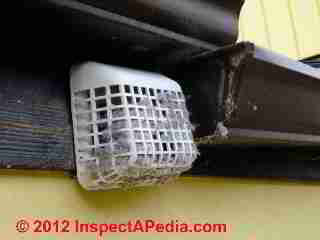
Our photograph shows a dryer vent screen including the protective cover provided by the manufacturer. This cover clogs rapidly and is in our opinion dangerous. It was removed and left-off of this dryer vent.
Watch out: there are too clearance distances specified between the wall exhaust point and other features -
see Wearing apparel DRYER VENT CLEARANCES & TERMINATION
For example, blowing dryer lint all over the air intake of an air conditioner compressor/condenser unit of measurement volition lead to higher air conditioning or heat pump operating costs, high temperatures at the unit, and possibly expensive damage to it.
Scout out: to exist certain that you use a listed, canonical clothes dryer vent termination cover, a self-closing dryer vent.
The exhaust vent embrace needs to allow warm moist linty dryer air to accident out of the building without causing a lint blockage in the dryer vent duct or at the vent opening (a fire hazard) while at the same time blocking bird or rodent entry into the dryer duct system (a fire hazard) and avoiding cold air backdrafts into the structure.
Too lookout out for improperly installed or sealed clothes dryer vent covers or terminations that permit water leaks into the building -
See CLOTHES DRYER VENT TERMINATION & SCREENS
Likewise watch out for clothes dryer vents that are in contact with building materials with special combustion hazards such as some cream insulation products.
Clothes Dryer Vent Exhaust Clearance Distance to H2o Heater
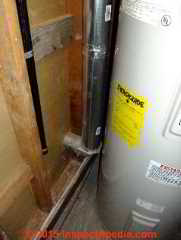 What are the risks if the dryer vent blows lint nearly a water heater or other types of heaters?
Reply: it depends
In our photograph at above/left I don't see any risk for the h2o heater in the routing of this dryer vent duct: the heater is electric so I'm not worried about lint leaks clogging up a gas or oil-fired burner (that would exist dangerous), and there is no heat or combustion run a risk created between the apparel dryer (on the other side of the division wall) and its frazzle vs. the electric water heater.
Watch out: detect that gas piping: a gas leak anywhere in the edifice would of course be very unsafe, risking fire or explosion.
Merely what about the furnishings of dryer lint leaks on other nearby mechanical systems. Not shown, merely nearby is an oil-fired heating boiler. Lint simply loves to accumulate on the oil burner air intake bands - possibly leading to poor heater operation and even in extreme cases, loss of heat.
This dryer is venting properly outside, merely before the installation you see at left was completed the contractor added foil tape or sealant where necessary to be sure that at that place was not lint leak blowing into the utility room.
Reader Q&A - besides see the FAQs series linked-to below
 @MikeC,
So they may take run into the very trouble that we've been speculating virtually. I can see 2 potential hazards:
ane. Likely: Lint harm to heater: lint from the dryer is sucked into the combustion air intake for the Rinnai water heater, causing a malfunction, possibly fifty-fifty affecting condom
2. Less likely simply possible: CO hazard: when the dryer is NOT running, and in particular if the dryer vent closure flap is not working - as is common due to lint bottleneck - there could exist dangeorus backdrafting of combustion gases from the heater's exhaust, entering the house through the dryer vent.
Unfortunately we don't know what the company considers "close to" - probably lawyerspeak for "continue us out of trouble by keeping it vague"
Earlier I suggested investigating extending the dryer frazzle further away;
If you lot make up one's mind to call Rinnai to get details do allow u.s.a. know as that will help other readers.
Watch out: in improver to safety and operating concerns arising from having a dress dryer exhaust vent too close to both combstion air intake and heater exhaust for your gas heater, in that location are besides required clearance distances between the heater vent and nearby projecting building walls.
That wall to the correct in your photo [shown below] may besides be too close; that'due south some other clearance to check with the Rinnai'southward installation transmission.
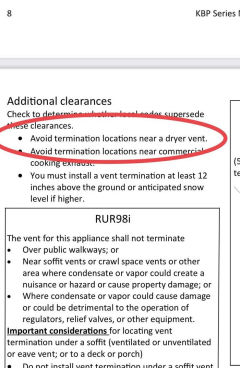
thanks for all the feedback. The Rinnai manual does say "avert" termination well-nigh dryer vents but that's information technology. Sounds like I probable don't have any direct code violations since dryer to Ac and dryer to combustion air intake don't take defined minimums, just in exercise the dryer lint can affect the water heater's performance equally lint burns onto the burners.
Since dryer to Ac condenser isn't defined, I think moving the dryer vent to the left would be cleanest pick.
Lint affecting AC unit is likely much less likely given how wind and air flow is in this corner of the firm and cleaning any lint off the condenser would exist simple compared to burner replacement in the tankless.
One other idea I had was to extend the air intake 2 or and so anxiety "away" from the business firm to distance it from the dryer but that wouldn't look clean and I'm non sure if that is a different violation.
@MikeC, thank you that's important feedback.
Did yous go annihilation in Rinnai near a business for dryer lint in the Rinnai's tankless h2o heater air intake?
Have you reviewed all of the distance involved in your dryer vent to see if yous could extend information technology up and sideways - peradventure indoors or outside - without exceeding the total allowable (and safely) run length?
Modern dryers do a ameliorate task at sensing unsafe temperature and shutting down, merely I still wouldn't desire to chance an add-on lint filter.
You'll notice that Rinnai gives clearances to combustion air INLETS of other appliances
Clearance to nonmechanical air supply inlet to building or the combustion air inlet to whatsoever other appliance (12 inches U.Due south., 36 inches Canada)
Clearance to a mechanical air supply inlet (Canada vi-feet, U.S. 3 feet (91 cm) above if within 10 feet (3 m) horizontally)
Nothing in those clearances addresses clearance to another edifice mechanical air OUTLET such as a dryer vent.
The Rinnai tankless water heater is taking its combustion air from outdoors - merely inches from its very own exhaust, though the air intake and exhaust outlet are not only to be separated as per the installation manual, but also utilize elbows or bends to confront in different directions - as in your photo. Pulling combustion air from outdoors helps keep the Rinnai water heater from fighting with the apparel dryer for combustion air.
Only the dryer exhaust vent, though more than-afar from the Rinnai air intake than the Rinnai'due south own exhaust, produces moisture and lint.
So what remains is to ask the company directly if they're worried about sucking dryer exhaust moisture or lint into the air intake of your Rinnai tankess h2o heater.
And of course for your installation you're assuming that the apparel dryer's own air INTAKE is coming from indoor building air and spaces and that it's not air starved. Anywhere that a dryer and other gas fueled heating equipment are fighting over combustion air at that place's a take a chance of fatal carbon monoxide poisoning - hence you also want working CO detectors properly located in your building.
We've definitely had issues with lint getting pulled into the combustion intake. Tankless started throwing codes and had to replace the burners at the melody of $k in labor. I'd love to move the dryer vent to the left away from the intake but it will move closer to the ac condensing unit and from what I read there could exist code saying that the dryer vent and Air conditioning unit of measurement must exist 6 feet autonomously? They are only 2.9 feet apart as it is at present. I feel similar I'm in a jam trying to
Information technology's a Rinnai Rur98i Install manual page 7 has vent locations
Rinnai Rur98i DIRECT VENT TANKLESS H2o HEATER WITH INTEGRATED PUMP INSTALLATION AND OPERATION MANUAL [PDF]
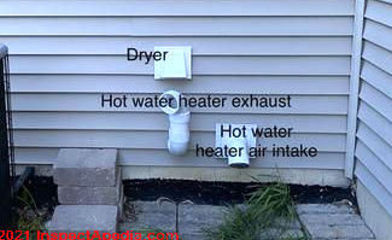 @MikeC,
GAS Appliance Straight VENT CLEARANCES at https://inspectapedia.com/chimneys/Gas-Heater-Direct-Vent-Clearances.php
gives code and typical clearance distances from a condensing boiler, furnace, or water heater exhaust to other building features like windows and combustion air intakes.
As the dryer vent is an exhaust, I think a concern may be sucking lint into the heating equipment'due south combustion system.
Let's get past theory to specifics past naming your tankless h2o heater make and model; then we tin can wait at its installation and functioning manual where the manufacturer'due south required clearances effectually its combustion air intake and exhaust, specific to that product, will be given.
Spotter out: in addition to rubber and operating concerns arising from having a clothes dryer frazzle vent too close to both combstion air intake and heater exhaust for your gas heater, there are also required clearance distances between the heater vent and nearby projecting edifice walls. That wall to the right in your photo may also exist too close; that's another clearance to check with the Rinnai's installation manual.
We have a directly venting tankless water heater that was installed a few years ago. It'due south air intake and exhaust are fairly close to the dryer exhaust. I'chiliad going to be getting permits pulled for an unrelated job soon and I'm wondering if the installer violated whatsoever codes with this placement?
It'southward > 12 inches from grade and > 12 inches from inside corner merely I can't find code details on directly venting gas appliance distances from dryer vents (if any such requirements exist)
[Photo above]
@Eric,
Dryer exhaust vents tin certainly exist routed up and out - merely I don't understand your question beyond that general remark, to which I add together
but check the total run length, number of elbows etc to exist sure y'all stay inside the dryer manufacturer's installation guidelines.
Tin can i install dryer wall vent on exterior wall viii ft above ground To avoid running the line another eight ft downwardly on the interior wall before exiting?
Margaret:
I can't give an united nations-arguable answer to the limits of contractor liability and even less for lawmaking officials. Let's focus first on safe and second on part.
That ways: vent the dryer to exterior properly, and in the course of that installation, audit the wall crenel to clinch that the dryer moisture hasn't caused a subconscious mold reservoir or that dryer moisture hasn't moisture and corroded nearby electric devices.
My Stance is that just a lazy idiot vents a dryer just into a wall cavity.
I had my basement renovated in 2006 and put in a laundry room. Since there was underpinning involved as I was excavation every bit I was excavation the foundation about two feet down and I was getting funding from the Canada Housing Corporation in forgivable loans, I had a structural engineer, an architect, a general contractor and a Toronto City building inspector involved.
I just learned that my dryer was non venting properly and to code. My dryer has been venting into my wall. I am getting some insurance structure work done and the general contractor had to reattach the dryer and discovered that in that location was no tube/duct work to attach the interior roll dryer vent.
I understand that the Toronto City codes concerning dryer vent systems changed in 2006. My laundry room renovation was completed in 2007. Apparently for years my dryer has not been venting safely. My electric current contractors have quoted me $770.00 to cut the drywall, install the proper tube, hook upward the dryer vent, drywall and paint the wall.
My question is, how long are contractors, city building inspectors and other professionals involved in a major dwelling house construction liable for their work? What if the work they did was not done to lawmaking and could non be seen because it was covered with drywall? Should I contact the original contractor and enquire them to rectify the matter? Has it been too long for the original contractors to be responsible for properly venting my dryer? Is the Building Inspector responsible?
Whatsoever comments or suggestions near going forward would be greatly appreciated.
Thank yous.
Thanks Geri. Very helpful
Geri
Venting a dryer "UP" can be prophylactic provided that your total vent run, number of bends or elbows, vent size and fabric and termination details all meet the dryer manufacturer's specs.
Pinnacle priority: be sure you have properly installed, located, tested, working CO detectors and fire/smoke detectors in the building.
You might desire to take all of your gas-fueled appliances and equipment checked for proper functioning and also their environment checked to be certain at that place is adequate combustion air.
Proceed in heed that because a dryer is exhausting air from the building, in a tight infinite information technology could create a combustion air shortage for some gas burners.
Is it condom to have a gas dryer vent to run 10 ft directly up the basement concrete wall to be vented outside ? I bought a Brand New gas dryer five months agone considering we had a C O leak and fire department run late one evening. Now tonight with my Brand new gas dryer we merely experienced another C O build up.
Thanks. Appreciate your feedback.
I tin't say for sure, Lisa; your local edifice inspector is the final legal authority on lawmaking estimation.
Arm yourself with the manufacturer's installation instructions and requite a phone call and ask for assistance. The inspector will be on your side.
- I can hands access where the dryer exhaust exits the house and would also be able to access the concluding at the edge of the deck so I could make clean and inspect from both sides. Would a town building inspector have an effect with this set up?
Lisa
We've had other readers describe extended outdoor routings of dryer vents; information technology's washed, but uncommon. My worry is inadequate insulation, condensation, freezing, blockage.
You'll desire to be able to hands access the vent extension for both cleaning and to check that it's not blocked by frost or water ice.
the comment beneath from Anonymous is a reply from me! sorry for the confusion.
- The present location of the vent is where I plan to build a deck. The wall where the existing vent is located is only 1 story. The wall has a unmarried door, sliding drinking glass door and a window which makes relocation with a 3 foot perimeter from these items incommunicable. I cannot motion the location of the dryer and running internal ductwork to an alternate wall would be a huge attempt. Hence my thought to extend the ductwork externally. Even with the extension I would non exceed the maximum duct length.
Lisa
You could build such an insulated vent extension though I'm unclear why, and I worry virtually exceeding manufacturer'south recommended maximum duct length or reduced dryer effectiveness or frozen condensate in very cold weather - a blocked duct would, equally I come across you realize - be unsafe.
I live in NY (then cold and snowfall are an issue). Assuming I am well within the required footage for venting, can I extend a electrical dryer vent exhaust out 8ft from the house under a deck with it terminating at the deck'due south outer edge (i would insulate the outside "ducts", install at an angle downwards and away from the house for moisture to bleed and have the end of the duct at the cease of the deck so frazzle is expelled abroad from the deck, not under it)?
Yous are correct that if the dryer exhaust vent opening is in a location where it could be blocked by snowfall at needs to be protected or sufficiently high above ground. It's also my experience that those louvered indoor dryer vent openings are decumbent to clogging with lint which tin lead to a higher and then you need to be sure to keep the vent and the exhaust opening make clean.
We just had a licensed company install a new dryer vent for us. Our old one goes far up out the roof which fabricated cleaning hard and we were concerned most safety. The team recommended putting the vent directly behind the dryer. The vent goes out onto our front porch. They installed a louvered door. As they were installing I asked almost the usual recommended 12 inch clearance from the ground as the new vent is about one-half that from the top footstep of the porch where it is located (it isn't likewise far from the edge of the pace where it would be a foot from
The bodily ground). The guy said that 1 foot requirement would apply for a hood that directs air downwards but since they installed the louvered door with flaps we were ok to accept it closer to the ground. Is this true?
Aye, nosotros're looking at a lint clog problem at least
My dryer vent is at the most 6 inches from my Air-conditioning. I just realized this today. Is this a problem? Thinking when both run at the same time lint from dryer will accrue on Ac and Air conditioning is pushing air from AC and air dorsum into my dryer vent. Thank you, Debbie
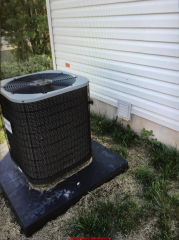
David
I would treat the crawl infinite vent to dryer vent altitude the same as for altitude between dryer vent and any other edifice ventilation opening such as windows and doors
https://inspectapedia.com/Appliances/Clothes_Dryer_Vent_Clearances.php#WindowWall
How far must the outside wall mounted dryer vent be from a crawl space frazzle vent?
Yes your dryer vent is too close to the ground - and I agree risks snow blockage.
The minimum recommended height above ground is 12" or in my opinion a height above the highest anticipated snow cover that may fall in the area of the vent. (That'southward what yous'll typically see in manufacturer's installation instructions for a clothes dryer vent termination or embrace.)
What is the edifice code for ground clearance of a dryer vent in Twin Falls, Idaho? Mine is only ane one/2 - 2 " and seems incorrect due to snow that we get. Thanks
That should exist okay provided your meeting the other clearances that are discussed in the commodity in a higher place. I'thou guessing that the location under the deck is assuring you that if you alive in the snow climate that the de chiliad assures that there'south no concern with the venting blocked past snow.
Can an frazzle vent from the dryer come out under a deck with a 20 inch basis clearance?
There is a 10-foot dryer vent Clearence discussed in the article above. It's not specific to Windows still.
Typically a three foot distance is required from windows to a dryer vent.
Keep in listen that your local Building Code Compliance inspector is the final legal Authority on this question
The odors from my neighbors dryer vents into my windows, Likewise soap smells. I live in a 17 story building in NYC. DOB said the vent needs to be 10' from living spaces (my windows). These are not.
But I don't come across that written anywhere and I'k trying to get that addressed. Neighbor will not allow an inspection, and then gathering info to write and want to be accurate.
Tin can y'all advise?
Thanks!
Hugh
I'm not sure what problem nosotros're solving here. But you may be able to extend the vent exhaust termination by the wall if at that place's some adept reason to do so - merely be sure it'due south tipped down abroad from the edifice so as to avoid a condensate back-drain problem and that it's protected every bit advisable.
tin can i put the vent piping 4 ft out from the wall if i insulate & support outside conditions ?
...
Continue reading at Apparel DRYER VENT CODES or select a topic from the closely-related articles beneath, or come across the complete Commodity INDEX.
Or see CLOTHES DRYER VENT CLEARANCE FAQs - Q & A posted originally at this commodity.
Or see this
Commodity Series
- Wearing apparel DRYER INSTALLATION & REPAIR - domicile
- CLOTHES DRYER ASBESTOS
- CLOTHES DRYER FIRE HAZARD WARNINGS
- Apparel DRYER Burn Enquiry
- Clothes DRYER LINT FILTER HAZARDS
- Dress DRYER LINT CLOG RESISTANT SCREENS
- CLOTHES DRYER Safe CHECKLIST
- CLOTHES DRYER TEMPERATURES
- CLOTHES DRYER TEMPERATURE MEASUREMENTS
- CLOTHES DRYER VENTING - home
- CLOTHES DRYER VENT BOOSTER FANS
- Clothes DRYER VENT CLEARANCES & TERMINATION
- CLOTHES DRYER VENT CODES
- CLOTHES DRYER VENT ENERGY SAVINGS
- CLOTHES DRYER VENT INSTALLATION
- CLOTHES DRYER VENT TERMINATION & SCREENS
- DRYER EXHAUST VENT DUCT Fabric & SIZE
- DRYER EXHAUST VENT HOOD TYPES
- DRYER Exhaust VENT INSTALLATION & ELBOWS
- DRYER Exhaust VENT ROUTING OPTIONS
- DRYER Exhaust VENT MISTAKES
- DRYER Exhaust VENTED INTO ATTIC
- DRYER EXHAUST VENTED THROUGH ROOF
- DRYER EXAUST VENTED INTO CRAWL
- DRYER INSTALLATION & OPERATION MANUALS
Suggested citation for this web folio
Apparel DRYER VENT CLEARANCES & TERMINATION at InspectApedia.com - online encyclopedia of building & environmental inspection, testing, diagnosis, repair, & problem prevention communication.
Or see this
INDEX to RELATED ARTICLES: ARTICLE Index to APPLIANCE REPAIR
Or use the SEARCH BOX constitute below to Ask a Question or Search InspectApedia
...
Ask a Question or Search InspectApedia
Questions & Answers on bath vent fan and fan ducting installation procedures, codes, standards.
Endeavour the search box only below, or if you prefer, post a question or comment in the Comments box beneath and we will respond promptly.
Search the InspectApedia website
Notation: appearance of your Annotate below may be delayed: if your annotate contains an image, spider web link, or text that looks to the software as if it might be a web link, your posting will appear after information technology has been canonical by a moderator. Apologies for the delay.
Technical Reviewers & References
Click to Show or Hibernate Citations & References
Publisher InspectApedia.com - Daniel Friedman
Source: https://inspectapedia.com/Appliances/Clothes_Dryer_Vent_Clearances.php
0 Response to "Can a Dryer Vent Be Next to a Door"
Postar um comentário